



In the Vineyard,
Field of Sticks…, I mean Dreams
Summer of 2014 was a season of firsts for our family, although in wine parlance it is known as third leaf, a term used to describe the third year after a vineyard has been planted. First though, some history. We planted in the fall of 2011. Fall planting is atypical. Most vineyards are planted in the spring. Ours was a risky decision because a newly grafted young vine can be more easily damaged by freezing weather than a more mature vine. Nevertheless, we planted the newly spliced vines, still verdant and leafy, in November 2011, gambling that the forecast of a mild winter would be accurate. In just a few short months, we knew that our steep, rocky slopes, coupled with the likelihood of cruel summer heat and possible drought, would be a hostile environment for young vines. So we gambled that a few extra months of “settling in” would allow for a healthy commercial crop by third leaf. In a matter of days after planting the 24,000 small leafy vines, a cold front blew through like the Mistral and I found myself the proud owner of a field of lowly sticks -Not a speck of green to be found on any of my new vines. “No worries” said my ever optimistic vineyard manager, Evan Bellingar. “Leaf drop always occurs but usually not this fast.” I tried to be optimistic but I admit that the uninspiring field of sticks that I had just paid $35k for made for a winter that tested my faith just a bit. First leaf occurred in 2012 and it was not an inspiring sight, but we staged a minor celebration anyway. At least the stickyard had come back to life and green shoots were celebrated as if they were a dove returning with an olive branch after Noah’s flood. Weeds and rocks towered over the spindly vines and more than a few times I fretted about how forlorn my weed infested “vineyard” looked. Second leaf occurred on schedule in 2013. Rocks and weeds again predominated but the sucker rods (24 inch high supports resembling welding rods stuck in the ground and tethered to each young vine to provide support) provided some row definition to where, one with a healthy imagination, could convince oneself that this rock patch might one day become a vineyard. Late that fall of 2013, stakes, end posts, and trellis wire were installed, towering over the weedy mélange, but at least providing some defined rows, columns and symmetry. By spring of 2014 the grape vines were “growing like weeds” and finally were taller than the trellis wire, weeds, rocks, and cover crop. By June 21, when Leslie and I got married, a vineyard had miraculously manifested itself with beautiful vines of 40” height while the weeds had been mowed for the big day and the rocks obediently faded into the vineyard floor. What a beautiful day it was!
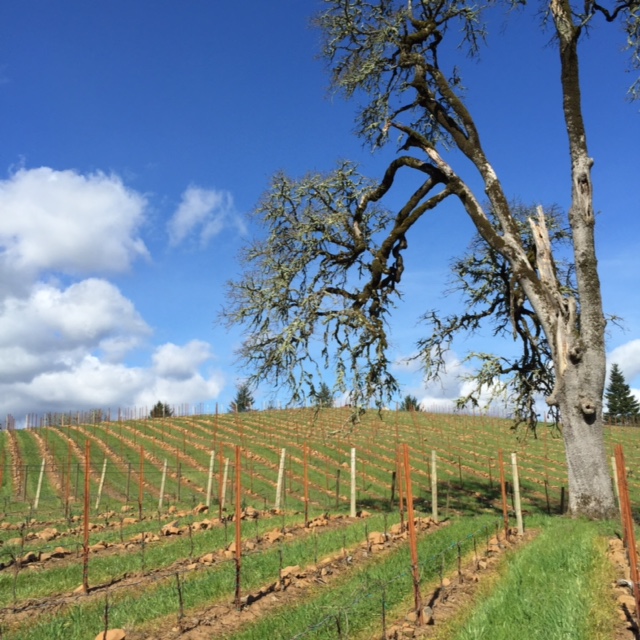
The field of sticks… er…
We harvested our Chardonnay on September 11 and I was amazed at the growth that had occurred just since our wedding a mere three months earlier. Finally, I had a real vineyard, with tons of luscious pale green chardonnay clusters gleaming in the sun. We harvested our three tons of Chardonnay grapes, at 23 brix, a measurement of sugar content, starting at 6 AM. We were done picking by 11 AM and at the winery by noon. Not bad!
Although the Chardonnay was picked at optimal brix and ripeness, Jared Etzel, our wine maker, wanted to maximize the hang time for our Pinot Noir thereby allowing, not only the fruit to reach optimal ripeness but also, the seeds and stems to fully ripen. He estimated another ten days before we should harvest the Pinot Noir. I flew back to Houston elated with the early Chardonnay harvest and ready for a few days rest before returning to Oregon for the Pinot Noir pick. At the time we were experiencing very hot temperatures and no rain so, a mere four days after returning to Houston, Jared called excitedly announcing that the Pinot Noir was perfect and we would harvest the following day, assuming Results Partners could procure the picking crew. Back to Oregon I jetted, having not even unpacked my bag from the Chardonnay harvest which had been very exciting for this rookie vineyard owner. But it was a relatively small deal since we only have two acres of Chardonnay planted.
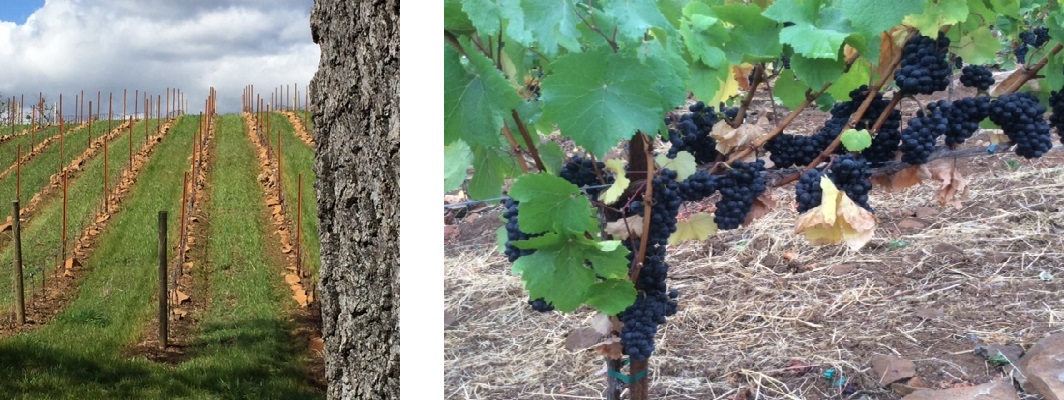
Dreams
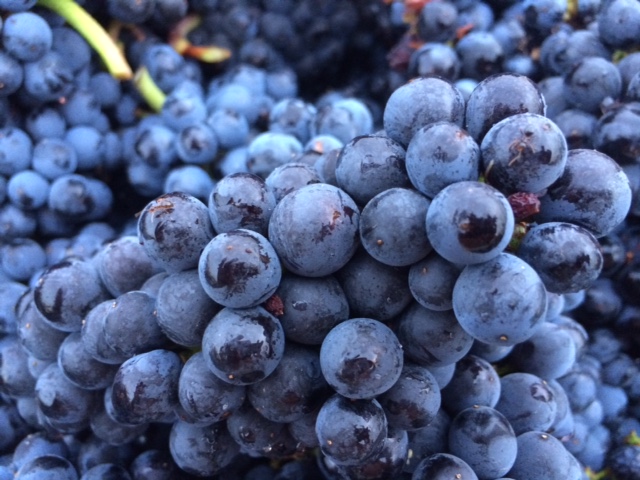
The morning of harvest for the Pinot Noir was another endeavor entirely. By 6:30 am I arrived at the vineyard facing cool and foggy conditions with rain threatening at any moment. It looked as if my vineyard had been repurposed as a used car lot. Small 10-15 year old pickups, SUV’s and compact cars were strewn up the hill, parked to the side of the newly completed 3,000 foot driveway, all the way from the county road to the top of the hill. Over 30 pickers, dressed in hoodies, CPO jackets and all manner of cold weather gear, were already there receiving last minute picking instructions about which blocks to harvest and how many tons were needed from each block. The pickers worked quickly, their strong hands expertly snipping the ripe fruit clusters from the vines, filling their 2 gallon plastic buckets and then running up the row to deposit their purple-hued treasure into the bins. Tractors, port-a-potties, mini-bins, the pick team, flatbed trailers and supervisors, all fulfilled their individual roles expertly in the early morning mist and fog. Indeed, I was witnessing a big operation. I watched in awe as the earnest migrant community toiled expertly to bring in the pristine cool fruit for us. We harvested 7.3 tons for our own estate Pinot Noir wine. The remaining 14 tons were sold to other wineries. We finished our pick by 1:00 PM and loaded 28 bins on the flatbed trailers and drove them to the winery. Before the hard working tribe could hurry to their next pick, I shook the strong calloused hand of every crew member and thanked them for their part in making our family dream come true. I am sure they wondered what this moist-eyed gringo was babbling about but they indulged me, shyly mouthed de nada and hurried on to their next job. Still feeling emotional, I decided to tour the vineyard and pull myself back together. As I walked the rows of vines that had just surrendered their treasure to the expert hands of the pick crew, I felt at one with nature, and this day and time in the cosmos. Peaceful. Maybe it was my imagination but the young vines looked spent. I continued my walking meditation thanking them for their yeoman’s service; I thanked them for carrying such a heavy load on their young spindly shoulders. I thanked them for a job faithfully and well done and wished them a well-deserved slumber. An emotional day indeed…and not even half done yet!
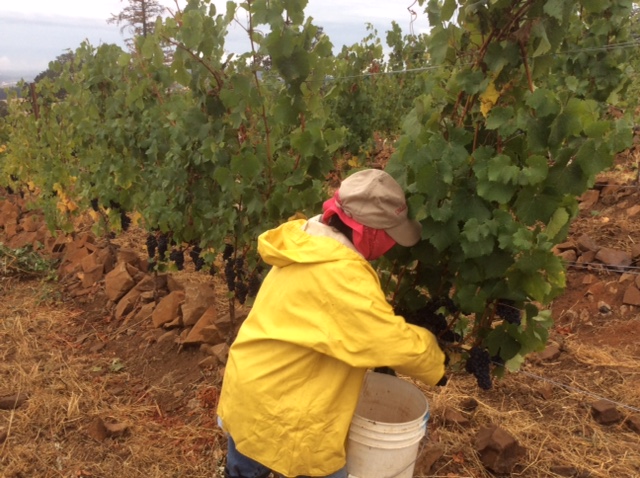
Harvest
…and… IN THE WINERY
The day was still blustery and overcast, even in the early afternoon, and the fruit was night- time cool and in perfect condition as we gently placed it onto the sorting line which was (wo)manned by eight females of various ages. Not a single grape escaped the piercing gaze of multiple sets of brown eyes searching for any slight imperfection, rot, mildew, sticks, leaves or insects which were discarded before reaching the destemmer. This is an expensive and back breaking way to sort fruit. But we think only perfect fruit should be in your wine and our meticulous attention to the tiniest of details will show up in your glass in the most satisfying way. Sorting and crushing the fruit took all day. After the sorting crew’s hand inspection, the grapes rode the conveyor belt into the destemmer and then down into a huge holding tank. Dry ice was added to the tank for a “cold soak” which extracts maximum color and richness from the fruit. Finally the fruit was pumped into new stainless steel fermentation tanks where they would bubble away happily as the natural yeasts catalyzed the fruit sugars into alcohol over the next few weeks. Later the young wine was pumped into our new French Oak barrels procured from Francois Freres where the magic osmosis of oak and fruit, sugar and alcohol are transformed into the nectar we all so enjoy uncorking on the occasions – big and small – that make up the pleasing texture of lives shared and well lived.
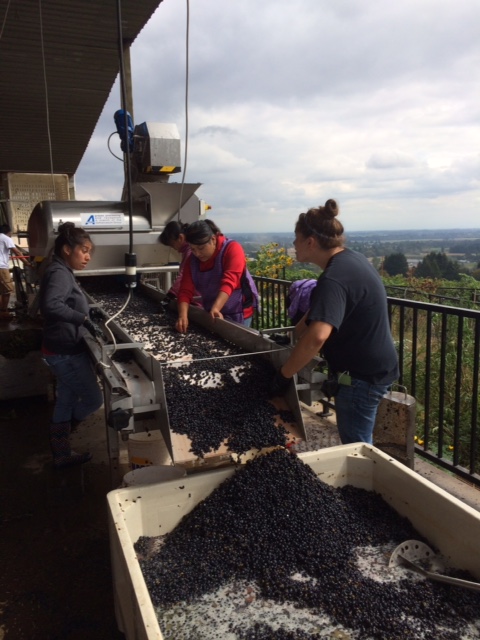
It’s common to harvest the current year’s crop and then bottle the prior year’s wine the very next day if it is ready. This allows about a month to get the barrels sterilized and ready to hold the current year’s new wine as it comes out of the fermentation tanks a few days or weeks later. The next day at an ungodly predawn hour the portable bottling line arrived to bottle our 2013 starter vintage. This is a semi-trailer equipped with a million dollars of automated bottling equipment inside. It is capable of bottling, corking, labeling, and boxing several hundred bottles per hour. The bottling crew consisted of six liberally tatted and pierced millennials, each responsible for a finite section of the bottling line e.g. intake, labeling, corking, boxing, and storage. Their work requires precision and attention to minute details (are you noticing a pattern here?). If a glitch occurs in the bottling line and goes undetected, it can cause debilitating quality problems, ruined wine and expensive “do overs” of the bottling, labeling, corking, and storage process. Because we had decided to use extra-long ultra-premium corks, we had an early problem in the process where the corks, when inserted by the machine, were not flush with the top of the bottle. Instead the corks protruded a mere 1/32nd” above the top of the bottle which made the tin capsule that encases the cork at the top of the bottle fit incorrectly. The crew quickly spotted the problem, made the needed adjustments and finished with a flawless bottling day. After bottling and casing the wine, the cases were forklifted back into the winery and loaded onto palettes, 49 cases to the palette. Within days our initial 2013 vintage of 200 cases was shipped to The Trappist Abbey nearby for climate controlled, perfect storage conditions to wait as shiners until our wine labels were approved by the TTB.
Our labels were designed by our family with assistance from Pail, a graphic design firm in Portland. We debated, rebated cussed, discussed every small detail of the label and color palette. In short, we were obsessive about every aspect of the design aesthetic. Every label must be approved by the TTB and our label was presented for approval in late January 2015. Once we received TTB approval, we had the labels and capsules printed and then applied to our “shiners” waiting patiently at the Trappist Abbey. Once the wine is labeled, it will be ready to ship to our buyers at last. I’m sure that we could have had our inaugural vintage into your hands in December 2014, were it not for my rookie mistakes and underestimation of the length of time required for regulatory approval. Not to worry though, the extra few months of bottle aging is allowing the wine to age in perfect conditions. When you receive your case(s) I’m sure that you will be glad you waited for it.
This post, coupled with the Thanksgiving 2014 post essentially summarizes the major events from the time I bought the rock pile…er field of sticks…um…weed patch …ahem… vineyard… up to the present. Future posts will be more frequent and timely (and shorter) as to goings-on in the vineyard and the winery so that you can enjoy the natural seasonal rhythms that drive our business. We hope our stories will be informative and maybe even entertaining … and … we hope our wine and the story of how we make it will connect you and your family with the rock and humus; the seasons and soul; the vision, the memories and the dreams of our land and our family. Thank you for reading our blog and for sharing our journey.
Post script: June 21, 2015 – On this momentous date, the summer equinox, Fathers Day and Leslie and my first anniversary, I am happy to announce that our wine is, at long last, available for purchase. We sell only direct to consumer which means that you cannot find our wine in any store or restaurant. It can only be purchased by ordering on our website or calling me direct. I look forward to sharing our wine with you and your family.
Happy Summer everyone!
The Terry Family
Order your 2013 Pinot Noir wine now.
We only made 200 cases and about 25% are sold. We look forward to hearing from you! Our contact information is:
https://andwinecompany.gcsmarket.com/| Rick Terry 503-839-6343
Please share this with your friends and fellow wine lovers. We are a new brand; unknown in the industry, and available only through direct sales at this time. Word of mouth referrals are so very appreciated.
Connect with us by following us on Facebook, Twitter, LinkedIn, Instagram and through our website. Our links are:
- https://www.facebook.com/andwinecompany
- https://twitter.com/andwinecompany
- https://www.linkedin.com/company/terry-family-wines
- https://www.instagram.com/andwinecompany/
- https://andwinecompany.gcsmarket.com/